How to Make a Cool Generative AI Newsletter
Think of a generative AI newsletter like a fun note you send to your friends each week. It's not just another boring email. It's your special way to share cool news and secrets about AI. When you do this, people start to trust you and think you're the smartest person to ask about this stuff.
Why a Generative AI Newsletter is Your Superpower
Starting a generative AI newsletter is like having a weekly chat with people you want to help. It's your chance to share awesome tips and news they'll actually want to read. Forget about those snoozy company updates that get tossed in the trash right away. This is about making real friends.
The world is full of so much stuff online! It's super noisy. But a newsletter is different. It zips right into someone's inbox. That's their personal, quiet space. You own that space. You can't get that on social media, where a tricky computer program decides who sees your stuff.
It really is a superpower for making people trust you. When you keep showing up with helpful ideas, you're not just trying to sell things. You're helping. And that makes you a trusted friend, not just another business.
Look Like a Big Deal and Stand Out
Every single week, you get a new chance to show how smart you are. You could share a cool thought on the newest AI thing. Or a quick how-to on a new tool. It shows you really know your stuff. Before you know it, people will think you're the expert. You'll be the one they go to with their AI questions.
This is how you build a team of fans who not only listen to you but also trust what you say. And that kind of trust is worth more than gold.
A great newsletter doesn't just tell people things. It makes a friendship. It's the difference between someone knowing your company's name and someone feeling like they know you.
Turn Readers Into Your Biggest Fans
Your newsletter is like planting a seed. It keeps your business in people's minds. So when a reader is finally ready to buy something you sell, who do they think of? You! It's like warming up a friendship without being pushy. Nobody likes pushy.
It's also a super smart way to work. Using computers to help make newsletters is a huge deal now. Lots of people who make newsletters, about 28% of them, are already using AI to get ideas. And guess what? A huge 42% of them say it saves them one to three hours every week! You can discover more insights about the state of newsletters and see how people are using AI. This means you have more time to make awesome stuff your readers will love.
So, a generative AI newsletter helps you build three amazing things:
- Trust: By always giving helpful tips for free.
- Being the Expert: By showing you know a lot and becoming the person to ask.
- Friendship: By having a direct, personal chat with your readers.
Finding Your Special Spot in the AI World
The world of AI is HUGE. It’s like a giant galaxy. If you try to talk about every new robot, every little update, and every single thing happening, your brain will explode. Seriously. It’s a recipe for a big headache.
The secret to a great generative AI newsletter isn't about being the biggest. It's about being the most special. You have to find your own little corner of the AI galaxy and be the king or queen of it.
Start with what your business is already great at. Are you a real estate agent who uses AI to find the perfect house? Awesome. Maybe you're a company that helps local pizza places with their ads. That's your starting point. Your newsletter shouldn't just be about "AI." It should be about "AI for your people."
Don't be just another voice in the crowd. Be the number one guide for "AI for dog walkers" or "AI for people who make wedding cakes." When you focus on a small group, something amazing happens: you become the only person they want to listen to.
Picking a Spot You Can Rule
The best spots are a mix of what you know and what a special group of people really needs. You're looking for a place that isn't already crowded with a million other newsletters saying the same exact thing.
A good way to start is just to think about who you want to help. Let's imagine a few ideas:
- A money helper: Your spot could be "Easy AI tools that help families save money." You're not talking about confusing stock market stuff. You're talking about simple apps that help with real-life problems.
- An art company: You could focus on "AI picture makers for small shop owners who can't hire an artist." Your newsletter would be full of tips, tricks, and cool examples.
- A helper for local shops: Your idea might be "Using AI to answer customer questions all day and night." This is a real problem you can solve for people.
See how each one is super focused? They solve one clear problem for one special group of people. That's how you get fans who really care about what you have to say.
Finding your angle can feel like a puzzle. But it's really about matching what you know with what a reader needs. Here’s a little chart to help you think.
Choosing Your Newsletter Focus
| Newsletter Idea | Who Is It For? | What You Could Write |
|---|---|---|
| For a Special Job | People in one field (like teachers, doctors, or artists) | "How teachers are using AI to make learning fun." |
| For a Type of Person | People with the same title (like bosses or salespeople) | "Top 5 AI helpers for busy bosses." |
| For a Favorite Tool | Fans of one AI program (like ChatGPT or Midjourney) | "10 secret Midjourney tricks for amazing pictures." |
| For a Big Problem | Anyone trying to solve a common problem (like finding new customers) | "How to get new customers using AI helpers." |
Any of these ideas can work. The trick is to pick one that you can get excited about writing for, week after week.
Let Your Personality Pop!
Once you know who you're talking to, you have to decide how you'll talk to them. The personality of your newsletter is its secret ingredient. It's what makes people feel like they're getting a letter from a friend, not a big, boring company.
Are you funny and love jokes? Or are you super helpful with clear, numbered steps? There's no wrong answer. But your tone should feel like the real you. If you're a teacher at heart, don't try to be a comedian. It will just feel weird. The most important thing is to be yourself.
And guess what? Being yourself works! Some studies show that writers who aren't afraid to share their real opinions get the most readers. People like hearing from other people, not just from a robot spitting out facts. You can discover more about how personalization impacts engagement rates and see how powerful being unique is.
What you think is your most special tool. Anyone can find facts about a new AI. But your story of using that tool to solve a problem? Only you have that.
Create Your Simple Mission
To stay on track, it helps to write a simple mission for your newsletter. This isn't some fancy business plan. It’s just one sentence to remind you what you're doing.
It usually looks like this:
"I help [Your People] do [Their Goal] by sharing [Your Cool Stuff]."
Let's use our earlier ideas:
- "I help busy real estate agents sell more houses by sharing weekly AI tips for finding new clients."
- "I help new singers get famous by teaching them how to use AI to promote their music."
This little sentence is like your treasure map. Every time you have a new idea for your generative AI newsletter, check it against your mission. Does it fit? If not, maybe save it for later. This sharp focus is what makes a newsletter feel important. It becomes the one email your readers can't wait to open.
Making Great Content Without Getting Tired

Okay, you found your special corner in the AI world. Hooray! That's the hardest part, for real. But now a big question is staring at you: how do you keep finding new, cool things to say every week without turning into a zombie? The idea of a calendar that's always hungry for more content can make anyone want to hide under the covers.
But it doesn't have to be a chore. The secret isn't to work harder. It's to work smarter. The best newsletters feel like magic to the reader, but behind the scenes, they run on simple, repeatable plans. The second you stop being scared of the blank page, making your generative AI newsletter actually becomes fun.
Here's your plan for making great stuff, week after week, without getting burned out.
Use "Content Buckets"
Instead of trying to invent a new masterpiece every single time, think in "buckets." These are just simple, repeatable formats that you can fill with new stuff each week. They give your newsletter a nice, cozy rhythm that your readers will get to know and love.
Having these formats ready to go takes away all the stress. You already know what it's going to look like. Your only job is to find cool ideas to put inside. Easy!
Here are a few content buckets that totally work:
- The Quick Tip: A short, helpful piece of advice. Maybe it’s one magic ChatGPT prompt that saves your readers a whole hour. It’s small, easy to read, and super useful right away.
- The Tool of the Week: Pick one AI tool and give it a short review. Who is it for? What's its coolest feature? Show a real example of how to use it.
- The News Blast: Quickly talk about the top 2-3 AI news stories from the week. The trick here is to add your thoughts—what does this news really mean for the people you're writing to?
- The Fun Test: This is where you get to play! Write about a funny or interesting experiment you did with an AI tool. Like, maybe you asked an AI to draw a "pizza party for dinosaurs." It's fun and shows the creative side of AI.
Just pick two or three of these buckets and switch them up. This simple system gives your readers something new and gives you a plan you can count on. It makes your generative AI newsletter feel fresh and totally doable.
Let AI Be Your Helper
You're writing about smart computers—so why not use one to help you? Think of an AI not as something that replaces your brain, but as the world's best helper. It’s amazing for getting you started when you feel stuck.
Don’t try to do everything by yourself. That's silly! The goal is to let AI do about 80% of the boring work—like coming up with ideas and making a plan. Then you can spend your time on the 20% that really matters: adding your unique voice, your personal stories, and your smart ideas.
This way, you're still the boss. You're just telling your helper what to do.
Here’s how to put your AI helper to work:
- Idea Explosion: Feeling stuck? Just ask the AI. A simple question like, "Give me 10 newsletter ideas for a baker who wants to use AI" can fill up your calendar for months in just a few seconds.
- Plan in a Flash: Once you have a topic, tell the AI to make a simple plan. "Make a plan for a newsletter about the 'AI Tool of the Week' featuring Midjourney." Bam! Your plan is done.
- Writing the First Draft: Use that plan to have the AI write a first try. It won't be perfect, but fixing something that's already there is way easier than starting with a blank screen.
- Making Your Own Pictures: Don't have money for photos? Use an AI picture maker like Midjourney to create your own images that match your words perfectly. It’s a great way to make your newsletter look special.
Make a Simple Plan
A content calendar sounds super fancy, but it doesn't have to be. It can be a simple chart or even just a list in a notebook. The whole point is to plan your topics a few weeks early so you’re not freaking out at the last minute. This one little step turns a messy rush into a calm, easy routine.
Your calendar can be super simple. Here’s what one month might look like for a newsletter about AI for small shop owners.
| Week | Date to Send | Main Topic (Your Bucket) | What to Ask Readers |
|---|---|---|---|
| Week 1 | October 7 | Tool of the Week: A review of an AI helper for websites. | "Want us to set this up for you? Let's have a free chat." |
| Week 2 | October 14 | Quick Tip: A 3-step guide for writing better AI questions. | "Reply to this email with your favorite question to ask an AI!" |
| Week 3 | October 21 | News Blast: What a new Google change means for your shop. | "Read more about it on our blog." |
| Week 4 | October 28 | Fun Test: We asked AI to write our spooky Halloween posts. | "Share this newsletter with a friend who loves AI!" |
This simple plan gets rid of the "What do I write about?!" panic. You know exactly what's coming up. This frees up your brain to make really great stuff. This rhythm is the secret to building a generative AI newsletter that people love for a long, long time.
Your Easy and Cheap Tech Tools
Getting lost in confusing technology is a fast way to ruin your good mood. But I have great news! You don't need a bunch of expensive, complicated stuff to start an amazing generative AI newsletter. You just need a couple of main things, and you can get it all going in one afternoon.
The goal is simple: spend less time fighting with computers and more time making cool stuff that people actually want to read. Let’s forget the confusing words and focus on what you really need.
Your Email Sending Machine
First, you need a way to send the emails. This is the most important part. A company that sends emails for you is called an email service provider (or ESP). This tool holds your list of readers, lets you design your newsletter, and actually sends it out.
When you're just starting, there are tons of choices. But a lot of them are stuffed with features you'll never, ever use. You want something that's easy and cheap.
Here are a few popular choices, explained simply:
- Beehiiv: This tool was made just for newsletters. People love it because it looks clean, it's easy to write in, and it has great ways to get more readers, even on its free plan. It’s a great place to start if you're serious.
- Mailchimp: This is one of the most famous names in email. Mailchimp is super easy for beginners and has a drag-and-drop tool to build your email. The free plan is good, but it can get expensive when you have more readers.
- Substack: If you just want to write and not think about anything else, Substack is the easiest. It puts a blog, a newsletter, and even a way to get paid all in one place. The downside is you can't change how it looks very much.
For most businesses that help people, a tool like Beehiiv is the perfect choice. It gives you professional tools to grow without being confusing.
The Only Tools You Really Need
Besides your email sender, you only need one or two other simple tools to make your life easy. Think of them as your trusty sidekicks.
Your tech stuff doesn't need to be complicated to be strong. A few simple, smart tools will always be better than a confusing system you never use. Choose easy and just get started.
To run a great newsletter, you're not juggling a dozen different apps. You're just connecting a few key things. Here's a look at a simple, powerful setup.
The Best Tools for Your Newsletter
A look at popular and easy tools for sending emails and making content.
| Tool Type | Easy Choice | What It Does |
|---|---|---|
| Email Sender | Beehiiv or Mailchimp | Lets you keep your readers' emails, design your newsletter, and see who opens it. |
| Signup Form | The tool inside your email sender | A simple form you put on your website so people can sign up. |
| Writing Helper | ChatGPT or Claude | Helps you get ideas, make a plan, and write your first draft super fast. |
That’s basically it. You can run a whole newsletter with just these three things. An email tool to send it, a form to get readers, and an AI helper to help you write.
Connecting It All Together
The best part is that these tools are made to work together easily. Your email sender, like Beehiiv or Mailchimp, will automatically make a little piece of computer code for your signup form.
You just copy that code and paste it on your website—on your main page, your blog, or at the very bottom. Most website builders like WordPress or Squarespace make this a super simple copy-and-paste job that takes five minutes.
Once that form is on your site, anyone who fills it out is automatically added to your reader list. You don't have to do anything. It just works. This easy setup is all you need to start getting readers and sharing your smarts with your new generative AI newsletter.
How to Get Your First 1000 Readers
You can write the best newsletter in the entire world, but it doesn't matter if nobody reads it. Getting your first few readers can feel really, really hard.
But here's a secret: you don't need a bunch of money or some magic trick to get your first 1,000 readers. It’s all about starting with the people who already like you and being smart about how you share your work.
The whole thing is actually pretty simple. A new reader finds you, they sign up, and your email tool does the rest.
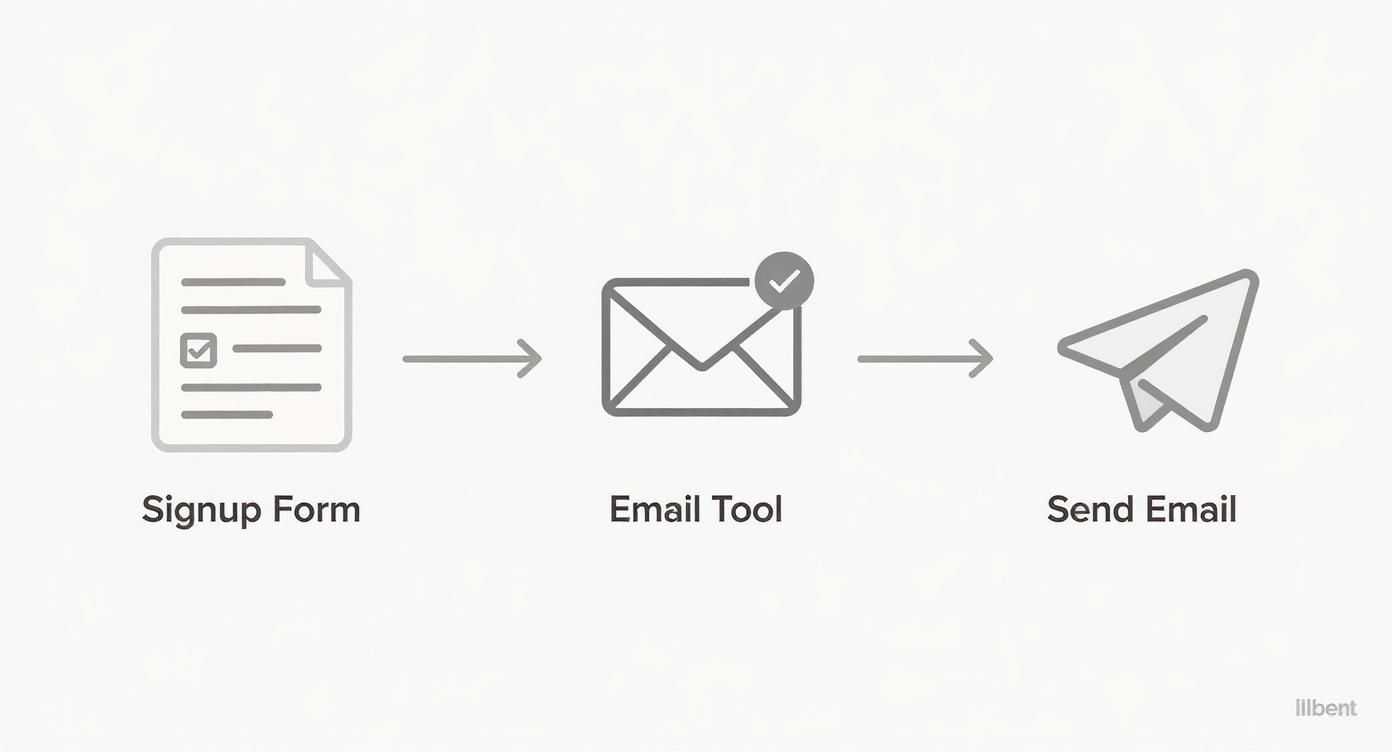
This simple flow is like the engine for your growth. Once you set it up, it works quietly in the background, turning curious people into your biggest fans.
Start with People You Know
Forget about bugging strangers for a minute. Your first 50 readers are probably already in your phone. These are the people who know you, trust you, and are happy to cheer you on.
Just make a quick list:
- Friends and family: They're your built-in fan club.
- Your clients (old and new): They already pay for your smarts, so they're the perfect readers.
- Friends from work: The people in your field who get what you're doing.
Then, send them a personal, friendly message. Don't send one giant email to everyone. Just a real note.
"Hey [Name], I'm starting a weekly newsletter with simple AI tips for [people like them]. I thought you might like it. No worries if not, but if you want to check it out, you can sign up here. It would be awesome to have you!"
That personal touch makes a huge difference. It's an invitation, not a sales ad. This first group is also the best place to get ideas on how to make your newsletter even better.
Make LinkedIn Your Friend
For a generative AI newsletter that helps other businesses, LinkedIn is like a treasure chest. But you have to treat it like a friendly chat, not a giant billboard. Just posting a link and yelling "Sign up!" is a fast way to get ignored.
Here's the smart move: reuse your newsletter content. Take one newsletter and chop it up into a few small LinkedIn posts.
Remember those content buckets we talked about? Each one is a post waiting to happen:
- That "Tool of the Week" becomes a post like, "I tried this new AI tool all week. Here's what I really think."
- A "Quick Tip" is perfect for a short, snappy post.
- Your "Fun Test" can be a poll: "I asked an AI to make a slogan for a donut shop. Which one is funnier? A, B, or C?"
At the end of each helpful post, add a friendly little nudge.
Something simple like: "I share tips like this every Tuesday in my AI newsletter. The link to join is in the comments."
You're giving away helpful stuff first, which makes people curious. They start to see you as a helpful expert, and signing up for more feels like the obvious next step. It's all about making friends, not just advertising.
Make Your Blog Work Hard for You
Social media gives you a quick burst of energy, but your blog is what builds slow and steady growth that lasts. This is where you let search engines like Google do the hard work for you.
About a week after you send out your newsletter, post the whole thing as a new article on your blog. This is a classic trick, and it works so well.
Here’s why this is a genius move:
- It builds a library: Your website becomes a collection of your expert AI ideas, showing everyone how smart you are.
- It brings in searchers: People Googling the exact problems you solve can find your blog, and then find your newsletter.
- It gives your content a second chance: An email gets read once. A blog post can keep finding new readers for months, or even years.
Just make sure every blog post has a clear newsletter signup form in it. A simple box that says, "Like this article? Get more AI tips in your inbox every week" works perfectly.
This way takes a bit longer, but it’s how you build a real audience—people who find you because you're answering their exact questions. That slow and steady growth is what turns a little project into a big, trusted resource.
Answering the Tough Questions About AI Newsletters
Let's be real. Starting an AI newsletter brings up some big questions. It’s totally normal to worry about how much time it will take, or if you'll run out of ideas, or if it will even work.
So, let's talk about those worries and answer them straight up. I want you to feel ready and excited, not scared.
How Much Time Does This Really Take?
This is always the first question, right? The honest answer is this: once you have a plan, you can do this in 3-4 hours a week. I'm serious. In the beginning, it might take a little longer while you figure things out.
Everything changes when you use templates and let an AI do the hard work. I've seen people save 1-3 hours every single week just by using AI helpers for ideas and first drafts. The pro move? Do your work in batches. Spend one chunk of time thinking of a whole month's worth of topics. Use another chunk for writing. A final one for editing. This turns a weekly panic into a calm, easy part of your week.
Can I Actually Make Money From a Newsletter?
Yes, but maybe not in the way you think. For a business that helps other businesses, a generative AI newsletter isn't about selling ads. It's about being the smartest and best marketing you do.
Think about it. You're showing up in your perfect client's inbox every single week, sharing amazing tips for free. You're building trust. When that person finally has the exact problem you solve, who will they think of first? You. That's how you turn readers into money.
Think of your newsletter as having hundreds of little chats at once. You're making friends with lots of people, so when the time is right, selling to them feels normal, not weird.
And you can still give people a little push. A simple, "Want to see how this could work for your business? Book a free chat" or "Check out our services here" is all you need. It’s a friendly way to lead interested readers to become paying customers.
What if I Run Out of Things to Write About?
This is a huge fear, but it's easier to solve than you think. The secret to having endless ideas is to just listen. Seriously, that's it.
- What are the top three questions your customers always ask you?
- What are people talking about on LinkedIn or X in your field?
- What’s a common mistake you see smart people making with AI?
Every single one of those is a newsletter topic just waiting for you. Your job isn’t to be a genius who invents new ideas. It’s to be a helpful expert who answers the questions people are already asking.
And don't forget your AI idea buddy. A quick question like, "Give me 10 newsletter topics for a person who helps dentists use AI" can give you enough ideas to fill your calendar for months. You'll soon see that the problem isn't a lack of ideas, but a lack of time to write them all.
Should I Post My Newsletter on My Blog Too?
Yes. A thousand times, yes. This is one of the smartest, simplest things you can do. It's called reusing your content, and it gives everything you create a second chance to shine.
When you post your newsletter on your blog a week later, you open the door to a huge new group of people. Search engines like Google can find your words and show them to people who are looking for exactly what you know.
This is how you get the most out of the work you already did. Just make sure you add a clear newsletter signup form to every single one of those blog posts. It creates a perfect circle: people find your blog through a search, they like what they read, and they sign up to get your next great article sent right to them.
Ready to stop being invisible and start being the "best answer" your ideal clients are looking for? Authority Echo helps you turn your expertise into a powerful visibility engine across search and social. We build the systems that get you seen, cited, and booked. Start with a free visibility audit to see how you rank today.