How to Lower the Cost of Getting New Customers
First, before you can make it cheaper to get new customers, you gotta know what you're spending right now. It's super simple, I promise. Just take everything you spent on selling stuff and getting the word out, and then divide it by how many new customers you got. Easy peasy. Knowing that number is step one.
What's This Customer Getting Cost Thing Anyway?
Do you ever feel like you're just throwing money into a big black hole and hoping customers magically appear? Yeah, let's fix that.
Your Customer Acquisition Cost (CAC) is just a fancy way of saying how much money it costs you to get one brand new customer to buy something. It's not a scary math problem. It’s like a report card for your marketing. It tells you if what you're doing is actually working.
If you don't know this number, you're just guessing. You could be spending a ton of money on ads that bring in people who only spend a few dollars and then disappear forever. That's how businesses go broke.
Why You Really, Really Need to Know This Number
Knowing your CAC is like getting a treasure map for your business. It helps you see some super important things:
- Which ads and marketing ideas are making you money and which are just eating your cash.
- How much you can even spend to get a customer and still make a profit.
- If your whole business idea can even work in the long run.
Think of it this way: if you spend $50 to get a new customer, but they only buy something for $30, you're losing money every single time. It's such a simple idea, but you'd be shocked how many small businesses just ignore it.
Your CAC isn't just some boring number. It's your guide. It shows you how to grow without going broke. Figuring this out can totally change the game for your business.
A Super Simple Example
Let's pretend you have a small shop that sells cool T-shirts online. Last month, you spent $800 on Facebook and Instagram ads. You also paid someone $200 to help you with marketing. So you spent $1,000 total. And with that, you got 50 brand new customers.
This picture shows you exactly how to figure it out.
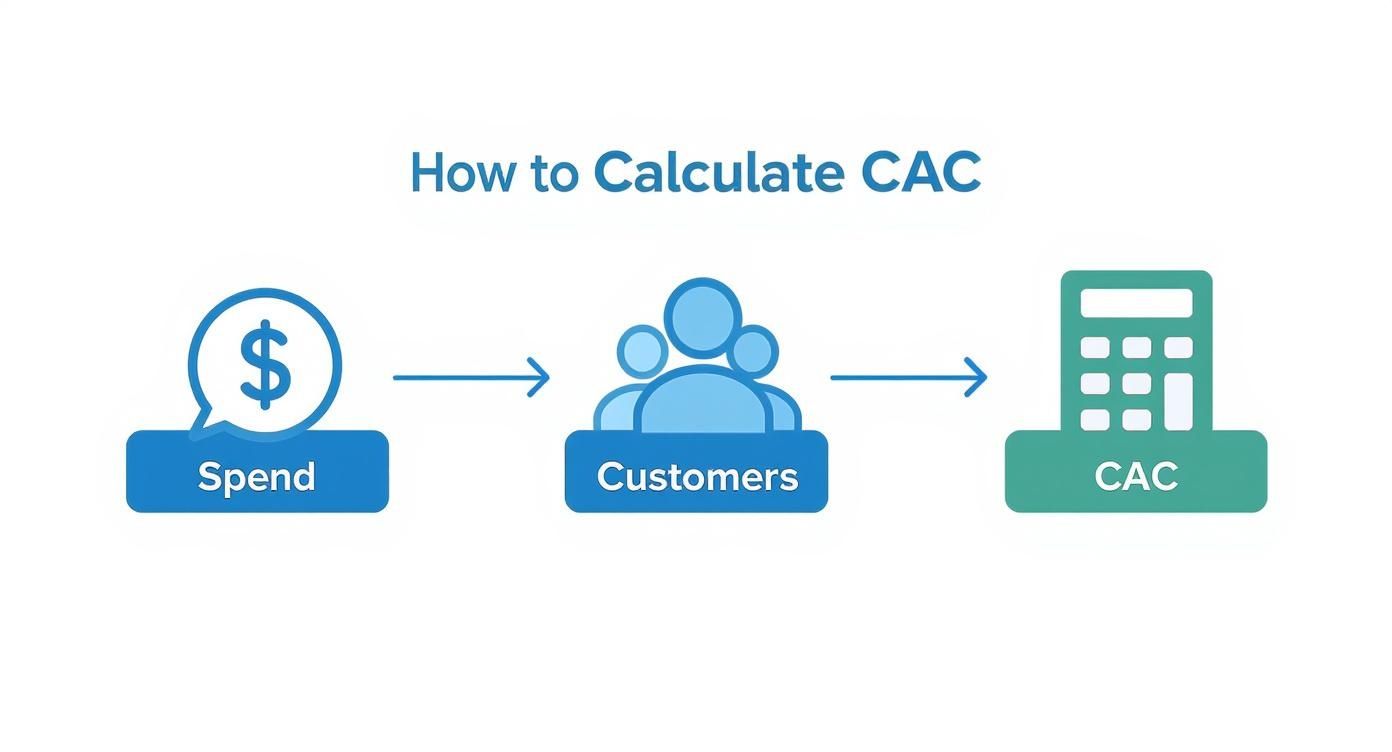
See? It cost them $20 to get each customer ($1,000 spent divided by 50 people). Now they have a starting point. They know exactly what it costs to get a sale, and they can start trying to make that number smaller.
Find Your People Without Spending a Ton
Stop yelling at everyone and hoping someone listens. Trying to sell to the whole world is like trying to catch all the raindrops in a tiny cup. You'll get tired and you won't have much to show for it. The real secret to getting customers for less money isn't about finding more people. It's about finding the right people.
These are the people who are already looking for what you sell. They’re typing their problems into Google. They’re asking their friends for ideas. Your job isn't to convince them they have a problem. Your job is to pop up and be the perfect answer they were searching for.
This is called organic marketing. It's like a magnet. It pulls people toward you instead of you having to chase them down with expensive ads.
Show Up Where They're Looking
What did you do the last time you needed to buy something? Did you wander around aimlessly? Nope. You probably grabbed your phone and Googled it. That little search bar is where your future customers are telling the world exactly what they want.
This is where Search Engine Optimization (SEO) is your best friend. It sounds techy, but it's not. It's just about being really helpful. When you make blog posts or videos that answer real questions, people find you, and they start to trust you.
Like, if you sell safe cleaning stuff, you could write a post called "How to Get Grape Juice Out of a White Rug" or "Are My Cleaning Supplies Safe for My Cat?" Someone searches for that, finds your helpful article, and boom—they've found a brand they like.
That one helpful article costs way less than a big, shiny ad, and it can keep bringing you customers for years.
Be a Big Deal in a Small Group
You don't need to be all over the internet. You just need to hang out where your best customers are. If you sell things to other businesses, that place is probably LinkedIn. It’s like a giant party for professionals that never ends.
But just having a page isn't enough. You have to talk to people.
- Share what you know. Don't just post "buy my stuff!" all day. Share cool tips, talk about what's new in your field, and give advice for free. Be the person everyone goes to for answers.
- Join the chat. Find groups where your customers are talking. If you're a money expert for new businesses, go hang out in the groups where they're asking about money stuff!
- Be a real person. When you ask to connect with someone, write a little note. "Hey, I saw we both like dogs!" is way better than a blank request.
Being on a site like LinkedIn is all about making friends. People buy from people they know and like. This is how they get to know you.
You don't need a giant pile of cash for ads. You just need to be helpful where people are already looking for help. Being real is the best—and cheapest—way to market your stuff.
Give Something Away First
The big secret here is to be generous. Instead of starting every conversation with "Wanna buy something?", start by giving them something cool for free. It makes people like you right away.
What's something your customers struggle with? Can you make a little something to help them out?
- A checklist for people buying their first house
- A calendar template for people planning social media posts
- A short guide on how to make a website go faster
When you give something useful away, you're not just getting their email. You're starting a friendship. You're showing them you get it and you know how to help. This brings in the best kind of customers and makes getting them way, way cheaper.
Make Your Website a Customer-Getting Machine
Getting people to your website is only half the battle. Your website is like your best employee. It works 24/7. But is it helping people and showing them right where to go? Or is it like a confusing maze that makes them want to leave?
Getting more of the people who are already on your site to buy something is a super fast way to lower your costs. You already paid to get them there, so now you just need to make it super easy for them to buy. This isn't about a big, expensive website makeover. It's about small, smart changes that make a huge difference.
Make it Easy to Buy
Every extra click, every confusing word, every box they have to fill out—it's like a little speed bump. If there are too many speed bumps, people will just give up and go somewhere else. The path from seeing your site to buying is called a sales funnel. Your job is to make that path super smooth.
Think about going to the store. If you can't find the milk, the line is super long, and the card reader is broken, you're just going to leave your cart and walk out. Your website is the same way.
Every little annoying thing you fix on your website is like opening another checkout line when it's really busy. You're just making it easier for people to give you money.
Try it yourself. Go to your own website and pretend you're a new customer. What's annoying? What's confusing? Fix those things first. One study showed that just making a website easier to use can make 200-400% more people buy something. That's huge!
Make Your Pages Work for You
Your landing page—the page people first see—has one job. Just one. It's to get the person to do one thing. That's it.
Don't fill it up with a bunch of links to your blog or your team page. If the page is about getting a free guide, then everything on that page should be about getting that guide.
A few easy changes can make a big difference:
- A Great Headline: The headline should talk about the customer's problem. Instead of "Our Services," try "Finally Get More Customers Without Spending a Fortune on Ads."
- A Clear Button: The button is so important. Don't use a boring word like 'Submit.' Use something exciting like 'Get My Free Plan Now!' The words matter a lot. Some studies show that changing the words on a button can get over 200% more people to click it.
- Show Proof: Use real quotes from happy customers. When people see that you've helped others just like them, they trust you way more.
Fix Your Shopping Cart
Did you know that almost 70% of people who put something in their online shopping cart just leave without buying it? That's a lot! They wanted to buy, but something stopped them. Usually, it's because paying was too hard.
Watch out for these common problems:
- Surprise Fees: Don't add a big shipping cost at the very end. Tell people about all the costs upfront. Nobody likes a bad surprise.
- Making Them Create an Account: Don't force people to make a whole account just to buy one thing. Let them check out as a "guest." Always.
- Too Many Steps: If people have to click through ten different pages to pay, they're going to give up. Try to make it just one or two simple pages.
These are all little fixes, but they add up. They make buying from you easy and quick. And when you get more of the people who are already there to buy, you make every dollar you spent to get them work a lot harder.
Let Your Happy Customers Do the Talking
What's better than you saying how awesome your business is? One of your happy customers saying it for you. This is one of the smartest and cheapest ways to grow your business. For real.
Every single happy customer you have could be a salesperson for you. They already know you do a great job. When they tell a friend about you, that friend is way more likely to listen than if they just saw an ad. Why? Because they trust their friend.
Turning your customers into your marketing team is a huge win if you're trying to figure out how to reduce customer acquisition cost. It creates a little circle where one happy customer brings you another, who brings you another, all without you spending more on ads.
Your Current Customers are Like Buried Treasure
Always trying to find new customers is super tiring and costs a lot of money. And honestly, it's getting harder and harder to do.
It costs a whole lot more to get a new customer now than it did a few years ago. But businesses that work hard to keep their current customers happy can see their costs to get new ones go down by 30-50%! By taking care of the people who already like you, you're not just making them happy. You're building a super cheap way to grow. You can find out more about this at LoyaltyLion.com.
It’s a totally different way of thinking. Instead of pouring all your money into a big funnel and hoping a few customers come out, you're investing in the people who already know you're great.
Make a Referral Program People Will Actually Use
Everyone says "ask for referrals," but most people don't do it right. A good referral program isn't about begging your customers for their friends' phone numbers. It's about making it super easy and fun for them to share.
Keep it simple. If your program is confusing, nobody will use it. It should be so easy a customer can explain it to a friend in 30 seconds.
Here's what a good one might look like:
- Make it Good for Everyone: Don't just give a prize to the person who refers a friend. Give the new friend something, too! For example, "Give your friend 20% off their first purchase, and you get a $50 gift card."
- Ask at the Right Time: Don't try to remember to ask. Set up an email that automatically goes out a week after a customer has a great experience. You want to ask when they're still feeling happy about it.
- Give Them the Words: Don't make them figure out what to say. Write a short, simple message they can just copy and paste to a friend. Make it so easy they can't say no.
The best referral programs don't feel like you're trying to sell something. They feel like you're helping a friend share something cool with another friend. That's the secret.
Reward Your Best Customers and Make Them Fans
A loyalty program isn't just about giving away free stuff. It's about making your best customers feel special. When people feel like they're part of a secret club, they buy more, stick around longer, and tell more people about you.
You don't need a crazy point system like an airline. It can be much simpler.
Real Example: A Business That Helps Other Businesses
Imagine you run a company that helps other businesses with their marketing. You could have a simple loyalty club.
- After 3 months: Your clients get a free 30-minute call with you to talk about anything they want.
- After 6 months: They get to try a new service before anyone else or get a small discount.
- After 1 year: They get a special gift and get invited to a private online class just for them.
This kind of thing does more than just get people to buy again. It makes them feel important. And when people feel important, they become your biggest fans. They'll tell everyone they know about you, which brings your customer-getting costs way, way down.
Do More of What's Working (and Stop What's Not)
Okay, it's time to stop throwing your money all over the place and hoping something works. That "spray and pray" idea is a great way to get so-so results and run out of money. You don't need to be on every single social media site. You really don't.
It's actually the opposite. It's way better to get really good at one or two places where your customers actually hang out than to be kind of bad on ten different ones. You need to be like a detective. Find the things that are really working and be brave enough to stop doing the things that aren't. When you focus your money and time, you get way better results.
Be a Marketing Detective
First, let's look at what you're already doing. This isn't a big, boring project. It's just asking one simple question for every place you're marketing: "Is this actually getting me customers?"
Forget about stuff like how many "likes" or "followers" you have. Those things feel nice, but they don't pay your bills. You need to be able to connect the money you spend to the money you make.
To do this, you need to track things. Even something simple like Google Analytics can show you where people are coming from when they visit your website. Find out which places are sending you people who actually buy stuff.
The goal isn't to be everywhere. It's to be where it matters. Putting all your effort into your best channel is almost always better than spreading it out over five okay ones.
This lets you make choices based on facts, not just what you feel like doing. If your blog brings in good customers but your TikTok is a total wasteland, then you know exactly what to do next.
Put More Gas on What's Working
Once you find your star players, it's time to give them more. Not just more money, but more of your time and your best ideas. Ask yourself: what's already working that I can do more of?
- Is your blog awesome? Could you turn your best blog post into a video or a longer guide?
- Is LinkedIn your jam? Can you spend 15 extra minutes a day talking to people in groups there?
- Do your emails make sales? How about you create a special deal just for the people who get your emails?
By focusing, you stop trying to be okay at everything and you become amazing at the things that really grow your business. This is super important now, because getting new customers is more expensive than ever.
The cost to get a customer went up by a crazy 40-60% recently. And a lot of businesses waste almost half of their marketing money on things that just don't work. By focusing on just your best two or three channels, you can lower your costs by 20-35%. You can learn more about these ecommerce CAC benchmarks and trends.
The Power of Saying "Nope"
Knowing where to put your time is half the job. The other half is knowing where not to. It can be hard to quit something, especially if you've already spent time on it. But if something isn't getting you real results, it's just wasting your time and money that could be making your best channels even better.
Stopping something that isn't working isn't failing—it's being smart. It frees you up to put all your energy into what's already proven to work. And that is one of the best ways to lower the cost of getting new customers.
Use Simple Tech to Make Your Marketing More Personal
Let's talk about using some simple tools to make your marketing feel like you're talking to a friend. We've all gotten those boring emails that say, "DEAR CUSTOMER," and we just delete them. Yuck.
Making things personal just means talking to people like you actually know them. It's about sending the right thing to the right person at the right time. And the tools we have today make that so easy. This isn't just for huge companies anymore. A simple setup can help you understand what your customers really want, which means you waste less money on ads and more people feel like you actually care.
Talk to One Person, Not a Huge Crowd
Let's say you sell coffee beans online. You have one customer who always buys dark roast and another who only buys decaf. Sending both of them the same email about your new light roast coffee is just annoying.
This is where a simple tool called a Customer Relationship Management (CRM) can help. It keeps track of what people buy so you can be more specific:
- For the dark roast fan: You can send an email that says, "Hey, we know you love strong coffee, so we wanted you to be the first to know about our new Sumatra blend!"
- For the decaf person: You can send them a special coupon for their favorite decaf beans.
That little change makes a huge difference. Your email goes from being a pushy ad to a helpful tip from a friend.
Let Robots Be Your Smart Helper
Using artificial intelligence (AI) sounds really hard, but it's one of the best ways to reduce your customer acquisition cost. Think of it like a really smart helper that automatically sends personal messages for you.
The numbers are pretty amazing. Studies show that businesses that use AI in their marketing have lowered their customer-getting costs by up to 50%. And, it can make you 5-15% more money. Why? Because you stop spending money on people who aren't interested and you focus on the ones who are. You can read the full research about these powerful CAC statistics if you want.
Your customers don't want to feel like just another person in a long list. Technology lets you treat every single person like they're your most important customer, without you having to work all day to do it.
Easy Ways to Get Started
You don't need a lot of money for this. Lots of email and website tools already have these things built in.
For example, if you're a consultant, you could use a simple tool. If someone downloads your guide about "Marketing on LinkedIn," the tool can automatically send them an email a few days later with a story about how you helped another company with that exact thing.
It's a small, automatic thing that shows you're paying attention. And that kind of helpful, personal touch is what turns someone who's just looking into a happy, paying customer.
Still Have a Few Questions?
Is your head spinning a little? That's okay. Let's go over a few questions people ask me all the time. This should help make things a little clearer.
What's a Good Price to Pay for a Customer?
To be honest, there's no one right answer. A "good" price depends on your business and how much a customer is worth to you over time.
The real test is to compare what it costs to get a customer (your CAC) with how much money they will spend with you over their whole life (your Customer Lifetime Value, or LTV). A really good goal is for the LTV to be about 3 times bigger than the CAC. So for every $1 you spend to get a customer, they should eventually spend at least $3 with you. If it's 1-to-1, you're not making any profit.
How Fast Will I See a Difference?
Some changes can work almost right away. I'm serious. If you fix your confusing checkout or rewrite a bad headline on a page, you could get more sales in just a few days. Those fixes directly make it cheaper to get each new customer.
Other things are more like planting a tree. Building up your SEO so people find you on Google or starting a referral program takes a little more time. They might take a few months to start working, but they grow into strong, steady ways to get customers for cheap that keep working for years and years.
The quickest wins come from fixing the problems you already have. The biggest, longest-lasting savings come from building real friendships with your customers.
Okay, What's the Very First Thing I Should Do?
If you're not sure where to start, begin with the one thing you have total control over right now: your website. You already did the hard work to get people there. Don't let them leave before they buy something!
Pretend you're a customer and go through your own site. Where is it confusing? What feels slow or weird? Fixing those little problems is usually the easiest and best first step you can take.
Ready to stop paying for ads and start being the answer your customers are looking for? At Authority Echo, we turn your expertise into a powerful magnet for inbound leads. Get your free visibility audit today and see how you stack up.