A Guide to a Thought Leadership Content Strategy
What’s a thought leadership content strategy? It’s your big plan to share what you know. But it’s more than just talking. It’s about being the person everyone trusts for answers in your area. You want to make stuff that really helps people solve their problems. This makes people see you as a leader and pulls in the right kind of crowd.
What Is a Thought Leadership Strategy Really
Okay, let's be real. "Thought leadership" is a fancy term people throw around. What does it even mean?
Think about it like this. Anyone can yell into a crowd. A real leader says something that makes people stop, listen, and go, "Whoa." You’re not just saying what everyone else is saying. You’re sharing your own special ideas, based on things you’ve actually done.
It all comes down to one big thing: trust.
When you keep sharing helpful, smart ideas, people start to think of you as the person to ask. A good thought leadership content strategy is your map for doing this. It helps you figure out what to say, who to say it to, and how to say it so it really sinks in.
From Knowledge to Growth
The main goal is to turn what you know into real growth for your business. It's a simple, super powerful idea: You start with what you know, you use it to build trust, and that trust turns into new friends, new chances, and more money.
It’s like a straight line from sharing what’s in your brain to earning a handshake and then seeing your numbers go up.
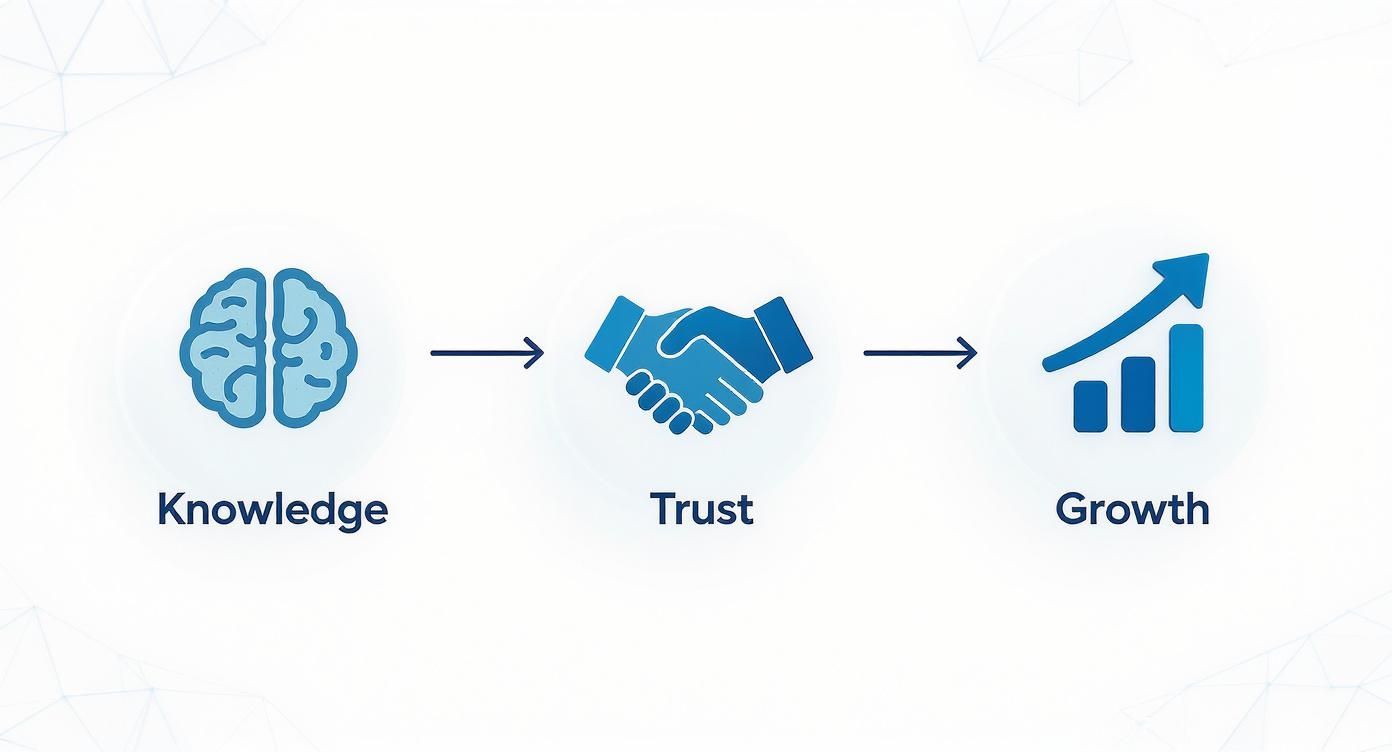
See? Each step leads to the next. You build up steam that makes your brand stronger and gets people to notice you.
This isn’t about showing off how smart you are. It’s about being truly helpful. A great plan always comes back to a few key things:
- Solving Problems: Your stuff has to give real answers to the hard questions people are stuck on.
- Building Credibility: You're showing people you know your stuff, not just telling them.
- Creating Connections: This opens the door to talk with people who might become customers or partners.
The best thought leadership doesn't even feel like selling. It feels like a good chat with a friend who gets what you're going through and has ideas to help.
In the end, a smart plan turns what you know into a magnet. Instead of you chasing people, they start looking for you. Why? Because they like your ideas and trust you to guide them. It’s about earning attention, not just buying it.
Finding Your Unique Angle and Core Topics

Before you write anything, you need to figure out what makes you special. If you just say what everyone else is saying, people will just scroll on by. The real magic happens when you find your secret sauce—that special way of seeing things that only you have.
Your unique angle is your superpower. It's what makes your content feel new and helpful, not like a boring copy of ten other articles. Getting this right is the first big step in a thought leadership content strategy that really works.
This is how you stop being another voice and start being a guide people trust.
Uncovering Your Secret Sauce
So where do you find this special angle? It’s usually right in front of you. It's a mix of what you've been through, what you believe in, and the problems you're really good at solving.
Think about your journey. What did you learn the hard way? What’s something you believe that other people in your field might not agree with? Those are the little seeds of great ideas.
Your unique point of view isn’t about trying to be different just to be different. It’s about being true to yourself and sharing things that only you can share.
For example, a marketing person who is amazing at helping small, local shops will have a totally different idea about social media than someone who only helps giant companies. That special, hard-won experience is their unique angle. It’s their story to tell, and it’s what will bring the right people to them.
Matching Your Expertise with Audience Curiosity
Once you know your special viewpoint, the next step is to connect it to what people are actually curious about. You need to find that perfect spot where what you know crashes right into your audience’s biggest questions.
This is where you build your content pillars. Think of these like the big chapters in a book about what you know. They’re the main topics you want to be known for.
Here’s an easy way to figure this out:
- Your Deep Knowledge: Write down 3-5 things you know like the back of your hand. What could you talk about for hours?
- Your Audience’s Pains: What are the top 3-5 problems your dream customer is dealing with? What keeps them awake at night?
- The Overlap: Where do those two lists meet? That spot is where your best ideas live.
This isn’t just about making content; it’s about making the right content. Doing this makes sure every article, video, or post you share is both true to you and super helpful to the people you want to reach.
Brainstorming Ideas That Don't Feel Stale
Now it’s time to fill up those big topic areas with specific ideas. Your goal here is to be helpful, not just loud. So instead of asking, "What can I sell?" try asking, "What can I teach?"
That one little change in how you think is a huge deal for your thought leadership content strategy. It's what separates real leaders from regular marketers. The help you give today builds the trust that brings you business tomorrow.
And this stuff really works! A recent study showed that 73% of bosses think thought leadership is a better way to judge a company than its ads. And get this—more than half of them (55%!) have bought more from a company just because of its smart content. You can dive deeper into the latest thought leadership statistics to see how big a deal this is.
Here are a few ways to come up with ideas that people will love:
- "I Wish Someone Had Told Me..."
Think back to when you were starting. What advice would have saved you a bunch of time or tears? Share that. It’s pure gold. - The "Common Myth" Takedown
What's a piece of advice everyone in your world gives that you think is totally wrong? Explain why, and show a better way. - The Step-By-Step Guide
Take something complicated that always confuses your customers and break it down into simple, easy steps.
By focusing on your special angle and building your topics around what people really need, you're not just making content. You're building a whole library that makes you the go-to person in your field.
Creating Content People Genuinely Want to Read

This is the fun part—making stuff that makes people stop scrolling. A waterfall of content hits our screens every second. So how do you make something that makes someone pause and really think? The secret isn’t just what you say, but how you say it.
A winning thought leadership content strategy uses lots of different tricks. It’s all about picking the right way to share your message for your audience. Some people love reading long articles. Others would rather watch a quick video on their phone.
The goal is to give them your knowledge in a way that feels easy and super helpful to them.
Matching Your Message to the Right Format
Think of your content types like tools in a toolbox. You wouldn’t use a hammer to cut wood, right? It's the same idea. A big, complex idea with lots of numbers might be perfect for a long report. But a personal story about a lesson you learned might be better as a short video or a quick LinkedIn post.
Here are a few examples:
- You need to explain a tricky process. A blog post with lots of pictures or a how-to video is your best friend. It lets people go at their own speed.
- You've got a strong opinion. A short, snappy social media post can start a conversation and get your point across super fast.
- You've found some new, interesting numbers. A cool picture (an infographic!) or a report makes boring numbers fun to look at and easy to share.
The best kind of content is the kind that's easiest for your audience to use. It makes your ideas simple to find, simple to understand, and simple to share.
Don't feel like you have to do everything. Start with one or two things that feel easy for you and that match where your dream customer spends their time online. It's way better to be amazing at writing blog posts than to be just okay at making videos, podcasts, and articles.
This chart can help you pick the right tool for the job.
Choosing the Right Content Format for Your Message
| Content Goal | Best Format To Use | Why It Works |
|---|---|---|
| Explain a complex "how-to" process | Detailed blog post or video tutorial | Lets you show step-by-step instructions and pictures, so people can learn their own way. |
| Share a strong, unique opinion | LinkedIn post or X (Twitter) thread | Great for short, punchy ideas that get people talking right away. |
| Present original data or research | Infographic or downloadable report | Pictures make numbers easy to understand and share, making you look like a pro. |
| Build a personal connection | Short-form video or podcast episode | Hearing your voice or seeing your face makes your ideas feel more real and friendly. |
| Go deep on a strategic topic | Whitepaper or webinar | Shows you're a true expert and is great for finding people who are serious about the topic. |
In the end, the format is just the box your idea comes in. Pick the one that will get your message to your audience with the least amount of work for them.
The Power of Storytelling and Simple Data
Let’s be honest: people don’t remember numbers; they remember stories. One of the best things you can do is wrap your knowledge in a simple story. Instead of just listing "5 Tips for This," tell a quick story about how you or a client used those tips to fix a real problem.
This little change turns your content from "information" into "insight." It feels more human, and it sticks in people's brains.
Sharing numbers is also a great way to show you know your stuff, but you have to make it easy to see. No one wants to look at a boring spreadsheet. Turn your important numbers into something pretty and clear.
- Simple Charts: A basic pie chart can make a surprising number jump off the page.
- Bold Numbers: Pull out the most important number and make it huge. Like, "8 out of 10 people struggle with this."
- One-Sentence Takeaways: Right after you share a number, explain what it means in plain English.
By telling simple stories and making your numbers easy to get, you create content that stays with people long after they’ve closed the page.
Your Framework for Creating Helpful Content
Making great content all the time can feel like a lot of work, but a simple checklist can help. Think of it as a final check for your thought leadership content strategy.
Before you share anything, ask these three simple questions:
- Is It Genuinely Helpful? Does this solve a real problem for my audience? If not, it’s just more noise.
- Does It Have a Clear Point of View? Are you just saying what everyone else says, or are you sharing your own special take on it?
- Is It Immediately Actionable? Can someone use one thing from this to help their business today? Real advice is what makes content great.
This simple check makes sure everything you make builds your reputation and trust. Each piece is a chance to make your audience feel smarter—and that's exactly what a real thought leader does. Your goal is to be the first person they think of when they're stuck.
Getting Your Ideas in Front of the Right People
Making a really great piece of content feels awesome. But if it just sits on your website, it's like having a brilliant idea and whispering it into a closet. It doesn't count until the right people see it. The best thought leadership content strategy goes way beyond just hitting "publish" and crossing your fingers.
This is all about sharing your ideas smartly. It’s not about being the loudest person in the room. It's about being the most thoughtful one. You need a plan to get your ideas in front of the people who need them, right where they're already hanging out.
Think Like a Community Builder, Not a Broadcaster
The old way was to just throw a link everywhere. That's just noise. The new way is to start real conversations. Your goal isn't just to get clicks; it's to build a small, friendly group around what you know.
Places like LinkedIn are awesome for this. Don't just drop a link and say, "check out my new post!" Instead, pull out one cool idea from your content.
- Turn a surprising number into a simple poll.
- Share a short, personal story that shows your main point.
- Ask a question that makes people think.
This little change makes a huge difference. You’re not just shouting about your content; you’re using it to connect with people. You give them a reason to talk to you right there, which makes them way more likely to click and see what else you have to say.
Your content isn't the finish line. It's the starting gun for a conversation. The real magic happens when people start talking back and see you as the center of the discussion.
The Magic of Working Smarter, Not Harder
You spent hours on that one big piece of content—a long article or a webinar. Don't just use it once! This is where the real secret of a great thought leadership content strategy comes in: repurposing.
Think of your big content piece like a big pizza. You have the main meal, but then you have leftovers for days. One great idea can give you stuff to talk about for weeks.
For example, that one long blog post can become:
- Five short LinkedIn posts: Each one is about one little tip from the article.
- A quick video script: Where you talk about the main points on camera.
- A simple picture: Showing the most important numbers in a cool way.
- A bunch of email tips: Sent to your subscribers over a few weeks.
This isn't about being lazy; it's about being super smart. You're respecting the hard work you put in by giving your idea lots of chances to reach different people. Some people love to read, others love to watch, and some just want a quick picture.
Repurposing lets you talk to all of them, without having to come up with something new every single day. This is how you stay consistent and build real power.
Meeting Your Audience Where They Are
The best idea in the world is useless if you share it in an empty room. A huge part of this is knowing where your dream customers spend their time online. It’s not about being everywhere; it’s about being in the right places.
If you help other businesses, LinkedIn might be your spot. If your audience loves pictures, maybe Instagram or YouTube is better. Don't try to be everywhere at once.
Instead, go deep. Become a known, helpful person in one or two key spots. Join conversations, answer questions, and share what you know. When you do share your own stuff, it won't feel like an ad. It will feel like you're just being helpful.
This is how you earn attention. You show up, you help people, and you build friendships. Over time, people won't just find your content by accident; they'll start looking for it because they know you have the answers. That's when you know your plan is really working.
Measuring What Actually Matters for Growth

So you've done the work. You're making helpful stuff and putting it out there. Now for the big question: Is any of it actually working?
It’s so easy to get excited about numbers that feel good but don’t really mean anything, like likes and follower counts. They look cool, but that’s it.
That's not what we're doing. A real thought leadership content strategy needs to be connected to how your business grows. We need to look at the numbers that prove you’re becoming a trusted voice and getting seen by the people you actually want as customers.
This is about proving your content is a powerful tool for your business, not just a fun hobby.
Moving Beyond Vanity Metrics
First things first: stop worrying about those feel-good numbers. We call them vanity metrics. They look pretty, but they don't tell you if you're actually making a difference. A post getting a thousand likes is nice, but it doesn't help you grow.
We need to look at numbers that show people are really listening and that you're becoming more trusted.
Think about it: would you rather have 10,000 random followers or 100 followers who are your perfect customers? It’s a no-brainer.
The goal isn't to be popular; it's to be important to the people who matter most to your business. Looking at the right numbers is the only way to know if you're on the right path.
This means we need a different way to keep score. One that shows a clear line from your content to real business goals, like getting good leads and building a great reputation.
Your Simple Authority Dashboard
You don't need a crazy, complicated chart to track what's important. A simple dashboard with just a few key numbers can tell you everything. These are the numbers that show your leadership is really growing.
Here are a few to start with:
- Website Traffic from Target Companies: Are more people from the right kinds of companies visiting your site? Some tools can even show you which businesses are looking at you. That's a huge sign!
- "How Did You Hear About Us?" Mentions: This is pure gold. When someone new wants to talk to you, just ask them that question. If they say, "I read your article" or "I saw your post on LinkedIn," you have a direct link from your content to a new customer.
- Inbound Media & Speaking Requests: Are people asking you to be on their podcasts, speak at their events, or write for their blogs? This is a giant sign that other people see you as an expert.
These aren't just fluffy numbers. They are real signs that your reputation is growing with the right people.
There's a reason for this. Businesses are spending more on this stuff because it works. B2B marketers have spent 53% more on thought leadership, and an amazing 60% of bosses say they'll pay more to work with a company that's a clear leader. You can learn more about how this strategy drives business decisions to get the whole story.
Connecting Content to Conversions
In the end, the most important number is how your content helps your business make money. This is where we connect the dots between an article and a new customer. It's not always a straight line, but you can definitely see the connection.
Here’s how you can see it:
- Content-Attributed Leads: Use your tools to see which blog posts or downloads are bringing in the best new contacts. This tells you which topics people really care about.
- Sales Team Feedback: Talk to your sales team! Are people bringing up your content when they talk to them? This is amazing proof that your ideas are helping warm people up before they even get on a call.
- Increased "Answer-Rank": Are you starting to show up as the top answer for important questions on Google? This is a clear sign that even Google thinks you're the expert, which brings you great visitors.
By measuring these specific things, you can prove that your thought leadership content strategy is more than just a marketing thing. It’s a powerful way to build trust, bring in great customers, and grow your business for a long, long time.
Answering Your Top Questions About Thought Leadership
Starting a thought leadership plan can feel like a big deal. It’s normal to have some questions.
Let's go over the ones I hear the most. Getting these sorted out is usually the last step before you can really get going.
How Much Time Does This Really Take?
This is always the first question, and it's a good one. The honest answer? It’s more about being steady than doing a ton all at once. You don’t need to spend 40 hours a week on it, but you do need to find a rhythm.
A great way to start is to set aside a couple of hours each week. One week, you could write a big article. The next week, you could use that time to break it into a few LinkedIn posts. It's all about building a habit you can stick with.
A couple of focused hours every single week will do more for you than one huge, crazy day once a month. Being consistent is the secret sauce for any thought leadership plan.
Do I Have to Be a Professional Writer?
Not at all. In fact, trying to be a "perfect" writer can sometimes get in the way. People don't want to read boring corporate stuff. They want to hear from a real person who knows what they're talking about.
Your goal isn't to win a writing prize. It's to be clear, helpful, and you. The best way to do that is to share what you know in your own voice.
- Write like you talk. Pretend you're explaining something to a friend over coffee.
- Keep it simple. You don’t need big words to sound smart. Being clear is what makes you smart.
- Tell your stories. The things you've been through are what nobody else has. They're your superpower.
What you know is the real treasure here. The writing is just the car that delivers it.
What if I Run Out of Ideas?
Everyone worries about this, but it’s almost never the real problem. You have way more ideas than you think. Feeling stuck usually just means you're thinking too big.
Go back to your audience. What little problems do they deal with every day? What’s one tiny piece of one of those problems you can help with? Listen to the questions people ask you on sales calls—every single one is an idea for content.
Your daily work is an idea machine. You just have to get used to noticing the problems you’re already solving and writing them down.
Ready to stop being the best-kept secret in your industry? At Authority Echo, we turn your expertise into the "best answer" across search and social. Our integrated system builds a momentum loop that drives qualified leads without the ad spend. Find out how visible you are with a free discovery audit today.