
Understanding Why Automate Payments for Your Business

Payment automation is changing the way businesses move money. Automated payment systems can reduce processing time by up to 75% and cut costs by as much as 60%. Most people expect the big advantage here is just doing away with paperwork and busywork. Yet the truly surprising benefit is how these digital tools give companies a whole new view of their finances, letting them spot cash flow problems before they start and making smarter money moves possible.
Table of Contents
- What Is Payment Automation And How Does It Work?
- The Benefits Of Automating Payments For Small Businesses
- How Payment Automation Enhances Cash Flow Management
- Key Concepts Behind Payment Automation Technology
- Real-World Examples Of Successful Payment Automation
Quick Summary
| Takeaway | Explanation |
|---|---|
| Automated payments save time and reduce errors | Automation eliminates manual processing, cutting transaction times by up to 75% and minimizing human errors. |
| Cut payment processing costs significantly | Businesses can lower expenses by 60% through automation, reducing labor and errors associated with manual work. |
| Gain real-time financial insights | Automated systems provide instant access to financial data, enhancing cash flow management and reporting accuracy. |
| Boost strategic decision-making capabilities | With predictive analytics, businesses can proactively manage cash flow and avoid potential liquidity issues. |
| Enhance customer payment experience | Automation enables faster, more reliable transactions, improving customer satisfaction and loyalty across various industries. |
What is Payment Automation and How Does it Work?
Payment automation transforms how businesses handle financial transactions by leveraging technology to streamline and simplify payment processes. At its core, payment automation replaces manual payment methods with digital systems that can process transactions automatically, reducing human intervention and minimizing potential errors.
The Core Mechanics of Payment Automation
Payment automation functions through sophisticated software platforms that connect directly with your financial systems and banking infrastructure. These platforms use advanced algorithms to execute recurring payments, track transaction histories, and synchronize payment data across multiple platforms.
Forbes research indicates that automated payment systems can reduce processing time by up to 75%, significantly improving operational efficiency for businesses. The fundamental mechanics involve several key technological components:
- Digital payment routing systems
- Secure transaction encryption
- Real-time transaction verification
- Integrated financial reporting capabilities
Benefits Beyond Simple Transaction Processing
Beyond basic transaction execution, payment automation delivers strategic advantages for businesses. According to McKinsey & Company, automated payment systems provide comprehensive financial insights by generating detailed reports, tracking cash flow patterns, and enabling more accurate financial forecasting.
Businesses utilizing payment automation gain significant advantages such as reduced administrative workload, improved accuracy, faster transaction processing, and enhanced financial visibility. By eliminating manual data entry and reconciliation processes, companies can redirect human resources toward more strategic business activities, ultimately driving growth and operational excellence.
The table below outlines select research-driven statistics on how payment automation impacts business efficiency, providing a clear overview of its measurable benefits.
| Efficiency Metric | Statistic | Research Source |
|---|---|---|
| Reduction in processing time | Up to 75% faster | Forbes |
| Lowered payment processing costs | Up to 60% savings | Deloitte |
| Improved cash flow forecasting accuracy | Approximately 45% increase | American Express |
| Reduced manual reconciliation workload | Significant reduction | International Journal of Finance |
| Enhanced report generation speed | Dramatically faster | McKinsey & Company |
The Benefits of Automating Payments for Small Businesses
Payment automation represents a transformative strategy for small businesses seeking to optimize their financial operations. By implementing digital payment solutions, businesses can dramatically improve their financial management efficiency, reduce administrative burdens, and create more predictable cash flow processes.
Financial Efficiency and Cost Reduction
Automating payments provides substantial financial advantages that directly impact a small business’s bottom line. Deloitte research reveals that businesses can reduce payment processing costs by up to 60% through automation. This significant reduction stems from minimizing manual labor, reducing errors, and streamlining transaction workflows.
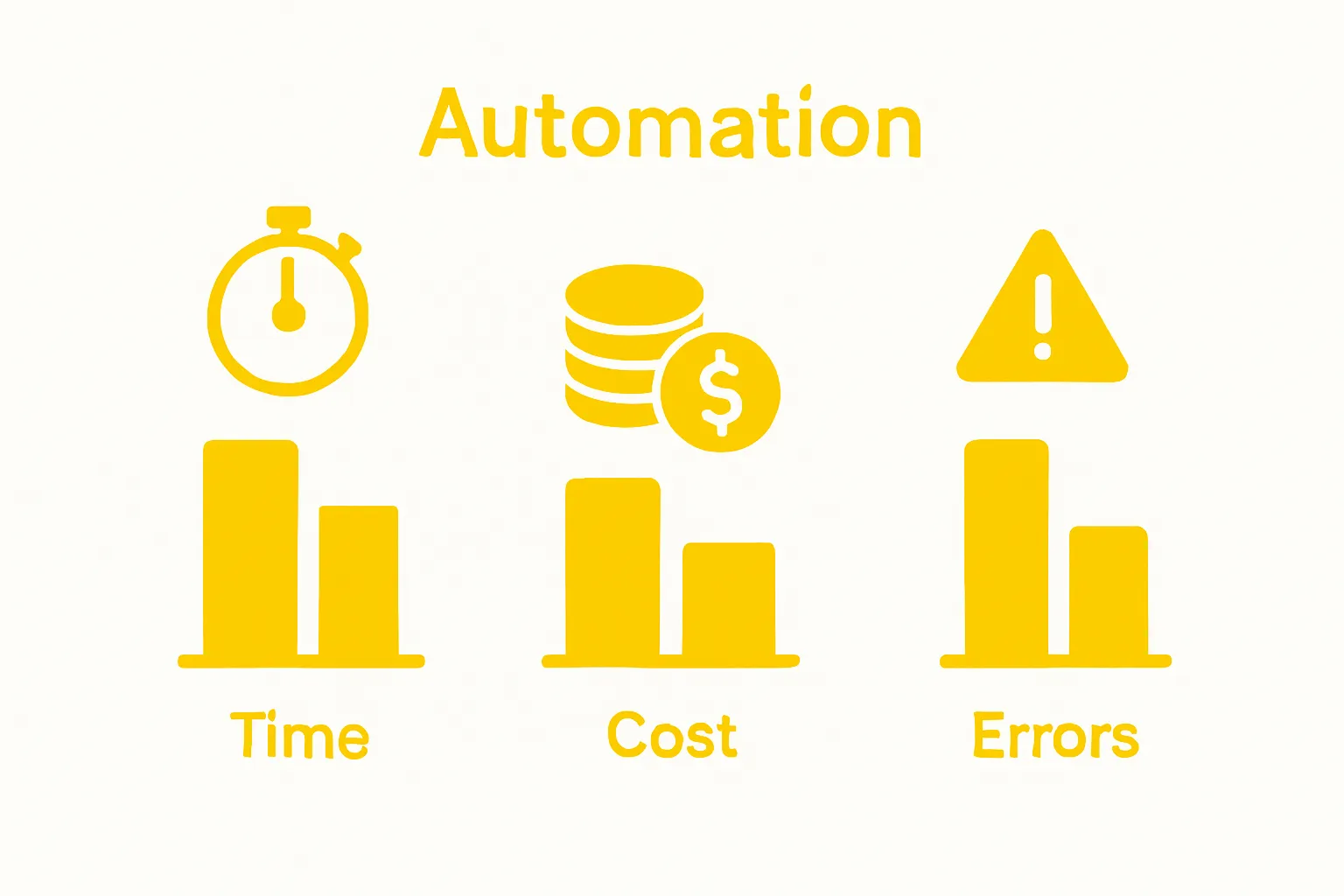
Key financial efficiency benefits include:
- Reduced labor costs associated with manual payment processing
- Decreased likelihood of expensive human errors
- Faster reconciliation of financial records
- Improved cash flow management and predictability
Enhanced Cash Flow Management and Reporting
Small businesses often struggle with tracking and managing cash flow, a challenge that payment automation directly addresses. By providing real-time financial insights and automated reporting, businesses gain unprecedented visibility into their financial health. American Express reports that automated payment systems can improve cash flow forecasting accuracy by approximately 45%.
Automation enables business owners to make more informed financial decisions by offering instant access to transaction histories, generating comprehensive financial reports, and providing predictive analytics that highlight potential cash flow challenges before they become critical problems.
Moreover, automated payment systems integrate seamlessly with accounting software, creating a synchronized financial ecosystem that reduces manual data entry, minimizes reconciliation time, and provides a clear, real-time snapshot of the business’s financial performance. This technological approach empowers small business owners to focus more on strategic growth and less on administrative financial management.

How Payment Automation Enhances Cash Flow Management
Cash flow management is a critical challenge for businesses, and payment automation provides a powerful solution to transform financial tracking and strategic planning. By leveraging advanced digital technologies, businesses can gain unprecedented control and visibility into their financial ecosystems.
Real-Time Financial Tracking and Predictability
Payment automation fundamentally changes how businesses monitor and manage their financial resources. International Journal of Finance research indicates that automated systems provide granular insights into cash movement, enabling more precise financial forecasting and strategic decision-making.
Key advantages of real-time financial tracking include:
- Instant visibility into incoming and outgoing transactions
- Automatic categorization of financial activities
- Predictive analytics for potential cash flow challenges
- Reduced manual reconciliation time
Strategic Cash Flow Optimization
Automated payment systems transform cash flow from a reactive process to a proactive strategy. By generating comprehensive financial reports and providing instant access to transaction histories, businesses can identify potential liquidity issues before they become critical problems.
The strategic benefits extend beyond simple tracking. Businesses can now:
- Set automated alerts for low account balances
- Schedule payments to optimize cash reserves
- Analyze spending patterns and identify cost-saving opportunities
- Create more accurate financial projections
By integrating advanced algorithms and machine learning technologies, payment automation platforms can predict potential cash flow disruptions, recommend financial adjustments, and help businesses maintain robust financial health. This technological approach transforms financial management from a reactive administrative task to a strategic business advantage.
Key Concepts Behind Payment Automation Technology
Payment automation technology represents a sophisticated blend of digital infrastructure, financial protocols, and advanced algorithmic systems designed to streamline transaction processes.
To help clarify the key technological elements supporting payment automation, the following table summarizes the core components and their specific functions.
| Technological Component | Description |
|---|---|
| Application Programming Interfaces (APIs) | Enable secure, real-time communication between financial systems |
| Data Encryption Protocols | Protect sensitive transaction information during processing |
| Real-Time Transaction Validation | Instantly verify and authorize payments |
| Intelligent Routing Algorithms | Optimize payment routing for speed and reliability |
| Cloud-Based Integration Frameworks | Seamlessly connect various financial software and services |
| Machine Learning Predictive Models | Analyze patterns and forecast financial risks |
Core Technological Architecture
Treasury and Risk Magazine highlights that payment automation fundamentally relies on application programming interfaces (APIs) that enable different financial systems to communicate and execute transactions automatically. These APIs act as digital bridges, allowing instant data transfer and synchronized transaction processing across multiple platforms.
Key technological components include:
- Secure data encryption protocols
- Real-time transaction validation mechanisms
- Intelligent routing algorithms
- Cloud-based integration frameworks
- Machine learning predictive models
Intelligent Transaction Processing
Modern payment automation technologies go beyond simple transaction execution. These systems employ advanced machine learning algorithms that can analyze historical transaction patterns, predict potential financial risks, and automatically optimize payment schedules.
The intelligent processing capabilities enable businesses to:
- Detect potential fraudulent transactions
- Automatically reconcile payment discrepancies
- Generate comprehensive financial reports
- Adapt to changing financial regulations
By combining robust security protocols with sophisticated analytical capabilities, payment automation technology transforms financial transactions from manual, error-prone processes into intelligent, self-regulating systems. The technology continuously learns and adapts, providing businesses with increasingly accurate and efficient financial management tools.
Real-World Examples of Successful Payment Automation
Payment automation has transformed financial operations across various industries, demonstrating its versatility and powerful impact on business efficiency. By examining concrete implementation scenarios, businesses can understand the practical applications and tangible benefits of this technology.
Service-Based Business Implementations
Harvard Business Review reports that service-based businesses have been particularly successful in leveraging payment automation technologies. Professional consulting firms, marketing agencies, and freelance networks have dramatically reduced administrative overhead by implementing automated invoicing and payment collection systems.
Key implementation strategies include:
- Automatic invoice generation based on project completion
- Scheduled recurring payment collections
- Integration with client management platforms
- Real-time payment status tracking
- Automated payment reminder systems
Retail and E-Commerce Payment Solutions
Retail and online businesses have revolutionized customer transaction experiences through sophisticated payment automation. These platforms enable seamless, secure payment processing across multiple channels, reducing friction in the purchasing journey and improving overall customer satisfaction.
Successful automation approaches encompass:
- One-click payment options
- Subscription billing management
- Automated refund and chargeback processing
- Cross-platform payment integration
- Instant transaction verification
By embracing payment automation, businesses across sectors are creating more efficient, transparent, and customer-friendly financial ecosystems. The technology not only streamlines internal processes but also enhances overall customer experience by providing faster, more reliable payment interactions.
Stop Losing Time and Money: Let Authority Echo Automate Your Payments
Manual payment processing eats up valuable hours and exposes your business to costly errors and awkward delays. If your team is overwhelmed by repetitive payment tasks, constant reconciliation, or slow cash flow cycles, you are not alone. This article showed that small businesses often lose efficiency and visibility without strong payment automation. Imagine replacing all that hassle with a system that handles everything from real-time transaction tracking to seamless financial reporting—all without hiring extra staff.

Ready to move past outdated processes and unlock higher cash flow accuracy? Discover how Authority Echo empowers service-oriented businesses to gain full control with automated payments, smart scheduling, and much more. Do not wait to streamline your payments and free up your team. Visit Authority Echo now to see how you can speed up payments, reduce administrative work, and create lasting client loyalty all in one unified platform.
Frequently Asked Questions
What is payment automation?
Payment automation is a technology-driven process that streamlines and simplifies how businesses handle financial transactions by replacing manual payment methods with digital systems that process transactions automatically.
How does payment automation improve cash flow management for businesses?
Payment automation enhances cash flow management by providing real-time financial insights, automated reporting, and predictive analytics that help businesses track cash movement and identify potential liquidity issues before they escalate.
What are the key benefits of automating payments for small businesses?
Small businesses can benefit from payment automation through reduced administrative workloads, lower processing costs, improved accuracy in transaction handling, faster transaction processing, and enhanced financial visibility, leading to better strategic decision-making.
What technology underpins payment automation systems?
Payment automation systems rely on a blend of technologies, including application programming interfaces (APIs), secure data encryption, intelligent routing algorithms, and machine learning models, which enable automated transaction processing and real-time financial management.