What Is Thought Leadership Marketing? A Super Simple Guide
Ever wonder how some people just seem like the person to ask about a certain topic? That's what thought leadership marketing does. It's not about yelling "buy my stuff!" with flashy ads. It's about becoming the go-to expert by sharing your smartest ideas for free.
It's like this: you teach people cool things, they trust you, and then they want to work with you when they need help. Simple as that.
So, What Does "Thought Leadership Marketing" Actually Mean?

Let’s pretend your car is making a weird clunk-clunk noise. Who would you trust more? A mechanic with a cheesy TV commercial? Or a mechanic who has a bunch of helpful YouTube videos explaining what that clunk-clunk sound usually means, in simple words you can actually understand?
You'd probably pick the helpful YouTube mechanic, right? Of course!
That's exactly what thought leadership is. It's a plan to become that super helpful, trusted teacher for the people you want to help.
It's Not Just a Fancy Word for "Making Stuff"
Lots of people think this is just about making blog posts or videos. Nope! That's just content marketing. Thought leadership is a special kind of content where the whole point is to share your own unique, smart ideas that make people see you as a real expert.
It's the difference between a tour guide who just reads facts from a little card and a tour guide who tells you amazing, secret stories about the city that nobody else knows. Both are giving you info. But only one makes you think, "Wow, this person really knows their stuff!" That matters. A lot.
Guess what? The big bosses and decision-makers are looking for this kind of stuff. Studies show that 52% of them spend at least one hour every single week reading or watching thought leadership. They want real smarts, not another boring sales pitch. You can explore more on these statistics to see the full picture.
The Big Idea: Thought leadership isn't about shouting the loudest. It's about being the most trusted voice because you're always sharing your best ideas and helping people out.
Let's see how this is different from the old-school way of doing things.
Thought Leadership vs. Old-School Marketing
Old-school marketing is like that annoying commercial that pops up in the middle of your favorite show. Ugh. But thought leadership? It wants to be the cool show you actually wanted to watch. This little chart shows what I mean.
| What it is | Old-School Marketing | Thought Leadership Marketing |
|---|---|---|
| The Goal | Get you to buy something NOW. | Build trust for a long, long time. |
| How it feels | Pushes a sales message ("Buy this!"). | Pulls you in with cool ideas ("Hey, think about this!"). |
| Who it's about | The company and its stuff. | You and your problems. |
| How you feel | "Ugh, go away." | "Ooh, tell me more!" |
| What they measure | Clicks and sales. | How much people like you and listen to you. |
So yeah. One way rents your attention for a minute. The other way earns it for good.
How It Works in Real Life
This whole thing creates, like, a magnet for customers. Instead of you chasing them, they start looking for you. Why? Because you've already proven you're helpful way before they even think about buying something.
Here's how it goes:
- You Share Cool Ideas: You post stuff that helps people with their biggest headaches in a new way.
- People Find You: They're searching online for answers (not for stuff to buy) and, bam, they find you.
- They Start to Trust You: Over time, they see you as a smart, friendly expert.
- They Pick You: When they finally need what you sell, you're the first person they think of. Maybe the only one!
This is totally different from regular marketing, which just interrupts people. This way attracts people by being awesome and useful. The goal is to build a reputation so good, it basically does the selling for you.
Why Being the "Go-To Expert" Is a Big Deal for Your Business
When you share your best ideas instead of just trying to sell something, you build something way better than a quick sale: trust.
Think of it like making a new friend. You wouldn't ask them to help you move on the first day, right? No way! You'd hang out, be helpful, and show them you're a good person first.
Thought leadership marketing is just like that. It's how you invest in your reputation, and it pays off big time later. It slowly turns your business from "just another company" into the "only choice" for the right people.
Get Better Customers and Awesome Helpers
Once you're known as the expert, something amazing happens. The best customers—the ones who already get what you do and respect your brain—start coming to you.
They aren't looking for the cheapest option. They're looking for the smartest one.
This also works for finding great people to work with! Smart people want to work for and learn from leaders. When you share your ideas, it’s like putting up a big sign that says, "Cool, smart people work here!" It makes your company a magnet for the best talent.
Make "Selling" Feel More Like "Helping"
You know that super awkward feeling on a sales call? Where you feel like you have to convince someone you're good enough? Yuck. Thought leadership totally flips that around.
When someone calls you after they've already read your articles or watched your videos, the hard part is over.
They're not calling you as a stranger; they're calling you as a fan. They already like your ideas. The talk changes from, "So, why should I pick you?" to "Okay, how can we do this together?"
The whole thing feels less like a sales pitch and more like two people figuring out a problem. It's just... better. For everyone.
Charge What You're Worth (and Get It!)
When people can't tell you apart from your competitors, they'll just pick the cheapest one. It's a race to the bottom. Being seen as the expert is how you stop that race.
When you're the known pro, your advice is just seen as more valuable. It's that simple.
This lets you charge more, and feel good about it! People aren't just paying for your time. They're paying for your special insight and the feeling of knowing you'll get the job done right. Your expertise becomes the one thing that makes you stand out from the crowd.
Help People Decide to Buy
Being a trusted source of info has a real effect on sales. People don't just read this stuff for fun; it actually changes how they buy things. Sometimes, it even shows them they have a problem they didn't even know about!
For example, a smart article could show a team a whole new way to solve a problem they never thought of. Big reports show that a whopping 75% of bosses looked into a new product or service after reading good thought leadership. And get this: 53% of buyers said this kind of content helped them decide what to buy. That's huge! Read more about the findings on how thought leadership impacts buyers.
This shows that when you're an expert, you're not just waiting for people to want something. You're helping create that want. You become the guide who helps them understand their own problems and leads them right to the best answer: you.
The Three Big Pieces of Great Thought Leadership
Real thought leadership doesn't just pop up out of nowhere. You have to build it. Think of it like a stool with three legs. If one leg is wobbly, the whole thing falls over. For thought leadership, those three legs are Expertise, Credibility, and Visibility.
Getting these three things right is what separates the real experts from all the other people just making noise online. Let's look at what each one really means.
Piece 1: Expertise—Your Special Magic
First, you need expertise. This isn't just knowing a bunch of facts. It's having your own special way of looking at things. A fresh idea. It's your secret sauce.
Anyone can follow a recipe from a cookbook. A true thought leader is like the chef who invents a totally new dish. Your expertise is your new recipe, made from all the things you've learned—the good, the bad, and the ugly.
Your job is to find your unique angle. What do you know that other people don't? What common problem can you look at in a totally different way? This is the heart of what you'll share.
The Big Idea: Your expertise isn't just what you know. It's how you think. It's the new idea that makes people stop and go, "Whoa, I never thought about it like that before."
Okay, once you know your special magic, you have to prove it's real.
Piece 2: Credibility—The Proof It's Real
Having a cool idea is great, but you need people to believe you. That's where credibility comes in. Credibility is the proof that makes your expertise real. It's how you earn trust.
Think about it. If some random guy on the street told you he discovered a new planet, you'd probably laugh. But if an astronomer from a big university said it—and showed you the data—you'd listen. The astronomer has credibility.
You can build this kind of trust by:
- Using Facts and Numbers: Show people the proof! It proves you did your homework.
- Sharing Real Stories: Tell stories about how your ideas helped real people solve real problems. A good story is way more powerful than just saying, "I'm great."
- Getting Shout-Outs: When other respected people or companies talk about you, it's like they're giving you a thumbs-up. Good reviews and being mentioned in the news work wonders.
Credibility turns your cool ideas into advice people can trust. It's the difference between saying, "I think this works," and "I can show you this works." Now for the final piece of the puzzle.
Piece 3: Visibility—Making Sure People See You
The smartest idea in the world doesn't help anyone if it's stuck in your head. That's why visibility is the last, super important piece. This is all about getting your smart ideas in front of the right people.
Imagine you wrote the most helpful book ever... and then you hid it in your closet. It helps zero people. Visibility is the job of getting that book out of the closet and into the hands of people who really need it.
This means you need a plan to share your stuff where your audience hangs out. This could be:
- Writing articles on your blog.
- Sharing little bits of wisdom on places like LinkedIn.
- Speaking at events or being a guest on a podcast.
- Teaming up with other experts.
The goal is to show up and be helpful, over and over again. You want to be the first person they think of when they have a problem you can solve. This picture shows how it all pays off.
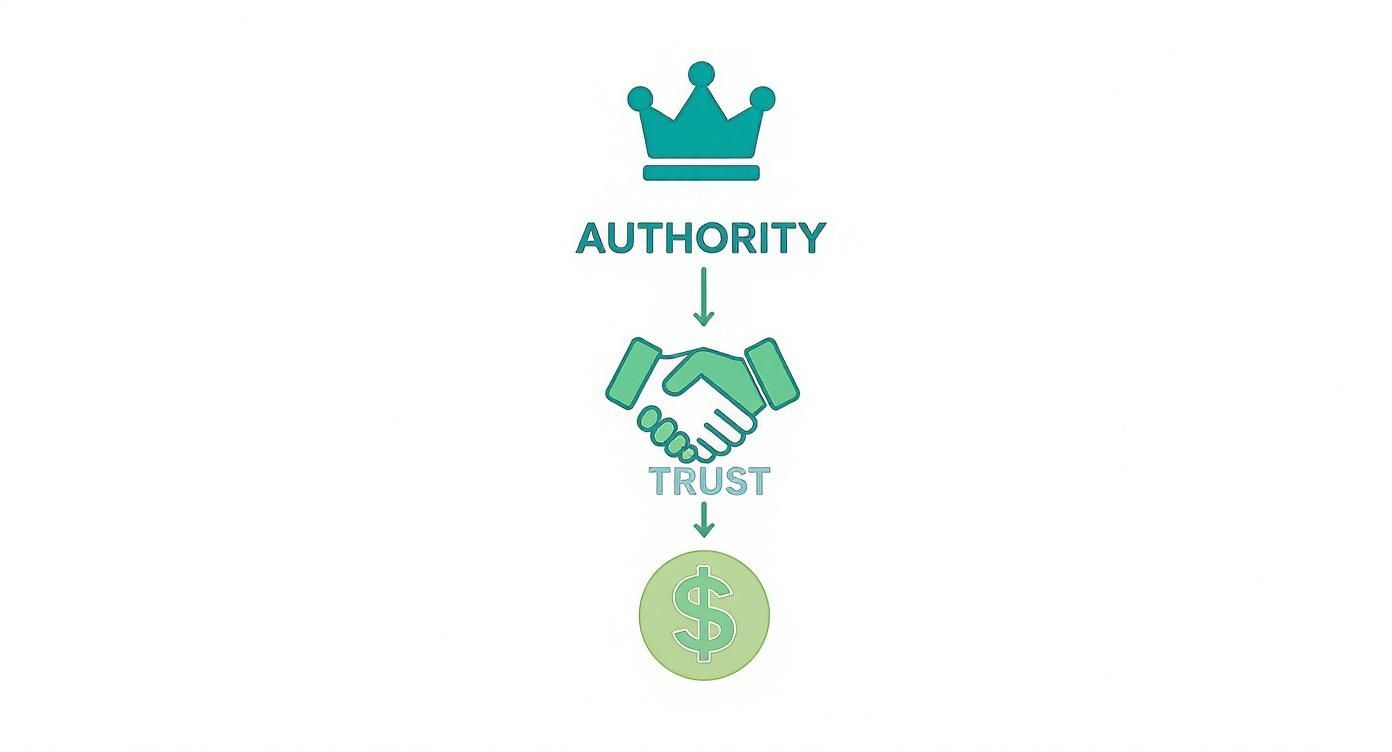
As you can see, becoming an authority (an expert) is step one. That builds trust, and trust is what gets you business. Without all three pieces—Expertise, Credibility, and Visibility—your stool will just wobble and fall over.
Cool Ways to Share Your Big Ideas
You don't need a giant budget or a fancy camera to become a known expert. It all starts with one simple thing: sharing what you know in ways that really help people. The trick is to find the right tools to get your awesome ideas out of your brain and into the world.
Here are some of the best ways to do it. The goal is to find one that feels fun for you and connects with the people you want to reach.
Writing: The Foundation for Everything
Writing is usually the best place to start. It's a great way to get your thoughts organized and create something helpful that people can find for years.
The most common way is a blog post or article. Think of these as the answers to your audience's biggest questions. A great article doesn't just list facts. It takes the reader on a little journey, from a tough problem to a clear, simple solution.
Another super powerful tool is the case study. This is just a fancy way of saying "tell a story." You tell the story of how you helped a real person solve a real problem. It’s solid proof that your ideas actually work in the real world.
A good article can work for you 24/7. It brings the right people to you by showing how smart you are long before you ever talk to them.
And don't forget about short stuff! Places like LinkedIn are awesome for sharing quick, smart thoughts. A little post can start a big conversation or just give someone a tip that makes their whole day better.
Pictures and Sound: Bringing Your Ideas to Life
Sometimes, showing or telling is way easier than writing. Videos and podcasts can make big ideas feel more personal and easier to understand. They add a human touch that words on a screen can't always do.
Here are a few easy things you could try today:
- Simple "How-To" Videos: You don't need to be a movie director! A simple video you record on your phone, where you explain something on a whiteboard or your computer screen, can be super helpful. It feels real.
- Webinars or Live Chats: Host a free online class or a casual "ask me anything" session. This lets you talk directly to your audience, which builds a real community and shows you know your stuff.
- Being a Podcast Guest: This is a fantastic trick. You get to go on someone else's show and share your smarts with their audience. It's all the fun of being on a podcast without any of the hard work of making one!
More and more businesses are realizing this is the way to go. A big report found that over a third of all businesses say that thought leadership is now their top priority. They're figuring out that if you can shape how people think, you can shape what they buy. Discover more insights from the 2025 B2B Thought Leadership Outlook Report.
Go Beyond Your Own Stuff
Sharing your ideas isn't just for your own website. One of the best ways to build trust is to have your ideas pop up in places your audience already knows and loves.
Writing an article for a popular website in your industry is a huge win. It's like getting a gold star from another expert. Speaking at a conference, even a small one, puts you on a stage and makes you look like a real authority.
Just find the way that feels most like "you" and helps people the most.
Common Mistakes That People Make (and How to Dodge Them!)
Getting started with thought leadership is super exciting, but a few common oopsies can stop you in your tracks. Think of this as a friendly warning about the hidden banana peels on the floor. If you know what not to do, you can build a plan that's real, lasts a long time, and actually works.
It's a marathon, not a sprint. Avoiding these mistakes will help you become that trusted, go-to expert.
Making It a Sneaky Sales Pitch
This is the biggest mistake ever. Please don't do this. Real thought leadership is about giving, not getting. The second people feel like your "helpful" article is just a tricky ad, you lose all their trust. And trust is the whole point!
Your main goal should always be to teach someone something cool or solve a problem for them. The sale will happen later, naturally, because they trust you. You don't have to force it.
Don't sell a product; sell an idea. When people believe in your way of thinking, they'll want to work with the person who showed them the light.
Focus on being the most generous teacher you can be. Share your best stuff for free. That's how you turn strangers into fans who wouldn't dream of hiring anyone else.
Being Super Inconsistent
Have you ever seen someone post one amazing article and then... poof! They're gone for three months? That's a great way to lose all your momentum. Being inconsistent is confusing and makes it impossible to build a real connection.
To be a leader, you have to show up. Again and again. It's like a friendship—you build it by being there regularly.
- Make a Doable Schedule: You don't have to post every single day. Just pick a rhythm you can actually stick with, like one great article a month or a few smart LinkedIn posts a week.
- Plan Ahead: Know what you're going to talk about before you have to. This stops the "oh no, what do I post?!" panic.
- Be Around: Even when you're not posting, join the conversation. Comment on other people's stuff and answer questions.
Being consistent shows you're serious and reliable. And that's what experts are.
Sounding Like a Robot (or Everyone Else)
The last trap is being boring and generic. If your ideas sound exactly like what everyone else is saying, you'll never stand out. Just repeating the same old advice doesn't make you a leader. It just makes you part of the noise.
Your power is in your unique point of view—the one you got from your own life, your own mistakes, and your own successes. Don't be afraid to have a different opinion or a new way of looking at an old topic. Ask yourself: what's something I believe that most other people in my field don't?
That unique angle is what makes people stop scrolling and really listen. It’s how you go from being just another voice to being the voice people look for.
Your Super Simple 5-Step Plan to Start
Ready to stop thinking about it and start doing it? Here’s a simple, five-step plan to get you going. No big, scary words, just a clear map to get you started today.

This isn't about being perfect. It's about starting, learning, and showing up to help the people you want to serve.
Step 1: Find Your "Thing"
You can't be an expert on everything. So, first, you have to pick one specific area where you can be the most helpful, smartest guide. This is your niche.
Think about where these three things meet: what you love, what you're good at, and what your audience really struggles with. Focusing on one small area is way better because you can become known for it much faster.
Key Takeaway: Don't try to be pretty good at everything for everyone. Be the amazing, go-to expert for a specific group of people with a specific problem.
Step 2: Listen Before You Talk
Before you make anything, you have to know what people actually need. The best leaders are the best listeners. Pay attention to the questions people are really asking.
Go to online groups, read the comments on blogs, and just listen when you talk to your customers. What drives them crazy? What do they wish they could do? Every question is a clue that tells you exactly what kind of stuff you should create.
Step 3: Pick Your Main Hangout Spot
Next, decide where you're going to share your ideas. Don't try to be everywhere at once—you'll get so tired! The trick is to pick one main spot and get really good at it.
Do you love to write? Your best bet might be a blog or LinkedIn. Do you like talking more than typing? Maybe a podcast or some short videos would be more your style.
Think about:
- Writing: Great for how-to guides and sharing smart ideas on LinkedIn.
- Video: Awesome for showing people how to do things or just having a friendly chat.
- Audio: Perfect for deep talks and reaching people with a podcast while they're driving or walking the dog.
Pick the one that feels the most fun for you and, just as important, is where your people already are.
Step 4: Make Your First Thing
Okay, it's time to make something! Your goal for this first piece is simple: be super helpful. Don't worry about it being perfect. Just focus on solving one little problem for your audience, clearly and with a smile.
It could be a short blog post that answers a common question. Or a quick video explaining a confusing idea. Just get something out into the world that gives people real value. This one action is the most important step of all.
Step 5: Start a Conversation
Last but not least, hitting "publish" isn't the end. It's the beginning! Once your stuff is out there, your job is to start talking about it.
Share it with people and ask what they think. When people leave a comment, reply to every single one. Ask them more questions. Talking with your audience shows you're not just shouting into the void; you're there to connect. This is how you'll get all your future ideas and build a group of loyal fans.
Getting started can feel tough, but breaking it down into little weekly steps makes it easy. Here’s a simple checklist for your first month.
Your First 30-Day Action Plan
| Week | What to Do | The Goal |
|---|---|---|
| Week 1 | Find Your Thing & Listen: Pick your topic. Spend 30 mins a day looking at online groups and writing down the questions people ask. | Know your niche in one sentence. Have a list of 10 real questions from your audience. |
| Week 2 | Pick Your Spot & Write: Choose your main platform. Write a messy first draft of your first piece of content that answers one question from your list. | Pick one channel. Finish a "good enough" first draft. Don't stress! |
| Week 3 | Polish & Post: Edit your draft to make it super clear and helpful. Then click publish! | Get your first helpful piece of content out into the world. Yay! |
| Week 4 | Share & Chat: Share your content on your spot and with a few friends. Spend 15 mins a day replying to any comments or questions. | Start your first real conversation and get ideas for what to make next. |
This simple pattern—listen, create, share, chat—is all it takes. By the end of the month, you'll have gone from just thinking about it to actually doing it, and you'll be ready to keep going.
Frequently Asked Questions
Let's answer a few of the worries that pop up before people start. These are the little questions that can stop you from ever starting, so let's get them out of the way.
How Long Does This Take to Work?
Think of it like planting a tree, not flipping a light switch. You might see people getting interested pretty quickly, but building real, deep trust takes time. It's a marathon, not a sprint.
It usually takes 6 to 12 months of showing up and being helpful again and again to really see the big results. The goal is to build something that helps your business for years, not just make a quick sale today.
This is an investment in your reputation. The trust you build is like a superpower that gets stronger over time, bringing you better clients and cooler opportunities.
Do I Have to Be Famous?
Nope! Not at all. This is one of the biggest myths.
Thought leadership isn't about being a celebrity. It's about being the go-to expert for a very specific group of people who have a very specific problem. Your goal is just to be the most trusted person in your little corner of the world, no matter how small it is.
What If I Run Out of Things to Say?
This is a really common fear, but the fix is easy: just listen more.
Pay super close attention to the questions your customers ask you every day. Listen to what they complain about online. Every single one of their problems is an idea for something you can create. Your audience will give you a never-ending supply of ideas if you just listen to them.
Ready to turn your expertise into the "best answer" everywhere your clients are looking? Authority Echo helps you get recognized and recommended across search engines, AI assistants, and LinkedIn without spending a dime on ads. Get your free visibility audit today and see how you rank.